
East End, West Dearborn and everything along the Rouge
Epoxy Flooring in Dearborn, MI
Garage, basement and shop floors for a city where seven in ten homes went up before 1960.
- Free on-site estimate with a slab moisture reading
- One written price that lists prep, coats and cure time
- Concrete is diamond ground and repaired before it is coated
A Dearborn Floor Is Usually Older Than Its Owner
Most epoxy flooring jobs in Dearborn begin on concrete poured before anyone in the house was born. American Community Survey figures show 24% of the city's housing was built in 1939 or earlier, another 22.3% in the 1940s and 24.4% in the 1950s. Only about 3% went up after 2010. So when you ask us to coat a garage or basement here, the first job is figuring out what seventy or a hundred years of use have done to the slab.
How the decades show up in the concrete
Each building era leaves its own kind of floor behind.
- 1920s and 1930s houses: small detached garages off the alley or the side drive, often with thin slabs, settlement cracks and several layers of floor paint.
- 1940s houses: many built quickly around the war years for plant workers. Basement floors here are often patched in sections where drains or laundry lines were moved.
- 1950s houses: wider lots and some attached garages. These slabs tend to be in better shape, but they have had seventy winters of salt at the door.
- Newer infill: a small share of the city. These floors are smooth and dense, and they still need grinding so a coating can grip.
That range is why we do not quote Dearborn floors by the square foot over the phone. Two garages the same size, three blocks apart, can need very different prep.
Neighborhoods built around the auto plants
Henry Ford built the River Rouge Complex here, the largest factory in his company, and Ford's world headquarters is still in the city. The company also shaped the housing. The Ford Homes Historic District holds houses the company built for its workers, and the Springwells Park neighborhood was laid out in 1939 by Edsel Ford for executives and auto workers. Present-day Dearborn is itself a merger: a 1928 vote joined the old city of Dearborn with neighboring Fordson, which had been called Springwells. The east and west ends grew separately for years, and you can still see it in the housing stock.
In these older blocks we often find basements that were finished, unfinished and refinished over the years. Tile glued to the slab, carpet tack strips, paint and old sealers all have to come up before a new coating goes down. Grinding removes them and opens the concrete underneath.
Two sides of the river, one sewer problem
The city developed on both sides of the Rouge River, and it sits at the end of the line for much of the region's sewer system. Michigan Public reported that the system was built for about three inches of rain a day, while the 2021 storm dropped seven inches on parts of the area within an hour or two. The city's own flood study found Dearborn can handle less than 3.5 inches of stormwater per rain event.
The city is working on it. It says clearing logjams on the Rouge raised the capacity to move water out of Dearborn by 70%, and new pumps, flap gates and backflow preventers are going in to protect more than 12,600 homes in East Dearborn. Five sewer separation projects have been designed, starting with an 800-acre area on the southwest side. Those projects cut the risk. They do not make a basement floor waterproof.
What that means for a basement coating
We treat every Dearborn basement as one that may get wet again. That changes a few choices:
- We test for moisture coming up through the slab, since a floor that took water can stay damp underneath for a long time.
- We favor a solid or light-flake finish that shows dirt and makes cleanup obvious.
- We keep the floor drain open and the slope toward it intact.
- We run the coating a short way up the base of the wall where it makes sense, so water cannot sit in the joint.
A coating will not stop a sewer backup. It gives you a floor that can be scrubbed, disinfected and dried in a day, with no carpet, pad or tile to tear out.
Garages, shops and the January thaw
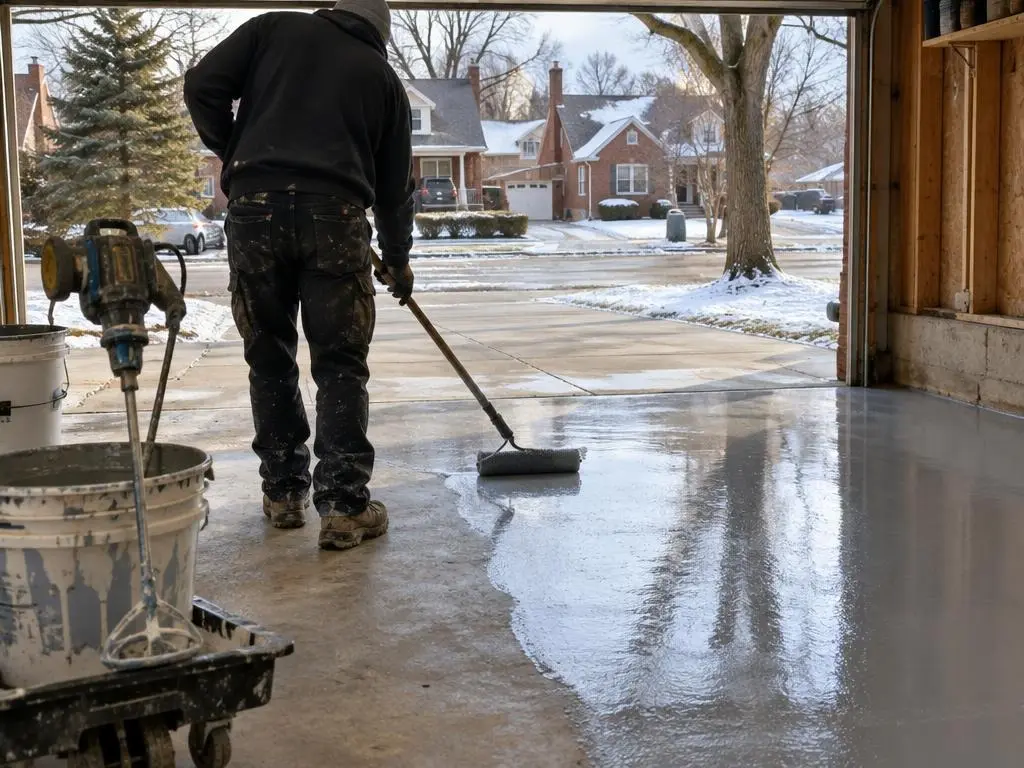
Dearborn's January days average about 32°F and its nights about 17.7°F, so a garage floor here thaws and refreezes over and over in a single month. For garages we usually suggest a flake system with a polyaspartic topcoat. It handles salt, holds up to hot tires and adds grip when the floor is wet. Polyaspartic also cures in colder conditions than standard epoxy, which helps with installs in late fall.
The city's industry runs well beyond Ford's offices. Repair bays, parts storage, small warehouses and the back rooms of shops along the commercial streets all have working concrete floors. For those we use thicker 100% solids epoxy, with concrete repair at the joints where carts and jacks do the most damage.
Metallic floors for finished basements
Not every Dearborn basement is storage. Many families use the lower level as a second living room, a play area or a gathering space. Where the slab is dry and sound, a metallic epoxy gives that room a seamless, poured finish with no grout lines or carpet seams. We will tell you honestly if your basement's moisture reading makes a decorative floor a poor bet.
Getting a price
We come out, measure, take a moisture reading and look at the slab. Then you get one written number covering prep, repairs, each coat and the cure time. Call (313) 217-4617 to set up a visit.
What to Know About Dearborn Floors
- Seventy percent built before 1960. ACS housing data shows a median year built of 1952, with 24% of homes from 1939 or earlier, 22.3% from the 1940s and 24.4% from the 1950s. About 73.9% are single-family detached houses.
- Rated for less than 3.5 inches. The city's flood study found Dearborn can handle less than 3.5 inches of stormwater per rain event. The 2021 storm flooded some 20,000 homes in under 24 hours.
- East End flood work. New pumps, four flap gates and backflow preventers are meant to protect more than 12,600 homes in East Dearborn, and Rouge River logjam removal raised outflow capacity by 70%.
- Freeze and thaw all winter. Under 1991 to 2020 normals, January averages a high of 32.0°F and a low of 17.7°F, with 30.8 inches of snow a year. Garage slabs cross freezing again and again.
Dearborn Questions
My Dearborn basement floor has old tile and glue on it. Can you coat over it?
No. A coating needs bare, open concrete to bond. We grind off the tile, mastic and any paint or sealer as part of the prep and include that work in the written quote. If the old tile might contain asbestos, which is possible in older homes, it needs to be tested before anyone grinds it.
Does the city's flood work mean my basement is safe to finish now?
It lowers the risk, but the city's own study puts current capacity at under 3.5 inches of stormwater per event. We suggest a floor you can clean easily, like a resin coating, and a separate conversation with a plumber about a backflow device. We coat once the slab tests dry enough.
Do you work in both East and West Dearborn?
Yes. We work across the whole city and the neighboring suburbs. The East End has more of the older 1920s and 1940s housing, so we often plan extra time there for paint removal and crack repair.
Free Estimates in Dearborn, MI
Free on-site estimates for Dearborn garages, basements and shops, with a moisture reading on every slab.
Epoxy Flooring Near Dearborn
- Epoxy Flooring in Dearborn Heights, MI
- Epoxy Flooring in Allen Park, MI
- Epoxy Flooring in Melvindale, MI
- Epoxy Flooring in Lincoln Park, MI
- Epoxy Flooring in Wyandotte, MI
- Epoxy Flooring in Southgate, MI
- Epoxy Flooring in Taylor, MI
- Epoxy Flooring in Romulus, MI
- Epoxy Flooring in Inkster, MI
- Epoxy Flooring in Westland, MI
- Epoxy Flooring in Garden City, MI
- Epoxy Flooring in Redford, MI
- Epoxy Flooring in Livonia, MI
- Epoxy Flooring in Canton, MI
- Epoxy Flooring in Plymouth, MI
- Epoxy Flooring in Northville, MI
- Epoxy Flooring in Trenton, MI